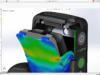
Calculate iso 6336 esaslı gear temas and diş dibi dayanımı Ön tasarımı using engineering units and the defined formula.
ISO 6336 Gear Contact and Tooth Root Strength Preliminary Design
Calculate iso 6336 gear contact and tooth root strength preliminary design using engineering units and the defined formula.
Result chart
Formula and calculation steps
Note: Results are for preliminary engineering evaluation. Verify assumptions, material data, safety factors, applicable standards, and manufacturer limits before final design. Tool version 2.7.1
How to use this calculator
- Enter the measurements and operating values.
- Select the correct engineering unit for each value.
- Press Calculate to view the result and intermediate values.
- Review the equation steps and download a PDF report if needed.
Equation used
Ft=2T/d₁; σH=ZH·ZE√[(Ft·KA·KV·KHβ/(b·d₁))((u+1)/u)]; σF=Ft·KA·KV·KFβ·YF·Yβ/(b·mn)
How to evaluate the result
Results are for preliminary engineering evaluation. Verify assumptions, material data, safety factors, applicable standards, and manufacturer limits before final design.
Technical references
Input guide for ISO 6336 Gear Contact and Tooth Root Strength Preliminary Design
Calculate iso 6336 gear contact and tooth root strength preliminary design using engineering units and the defined formula. The table below summarises the inputs and example starting values.
| Parameter | Example value | Units and description |
|---|---|---|
| Transmitted güç | 75 | kW |
| Pinyon devri | 1450 | dev/dk |
| Pinyon diş sayısı | 22 | Dimensionless or selection value |
| Çark diş sayısı | 66 | Dimensionless or selection value |
| Normal modül | 4 | mm |
| Helis açısı | 15 | ° — Enter the value required by the equation. |
| Yüz genişliği | 45 | mm |
| Uygulama katsayısı KA | 1.25 | Dimensionless or selection value |
| Dynamic katsayı KV | 1.10 | Dimensionless or selection value |
| Temas yük dağılımı KHβ | 1.15 | Dimensionless or selection value |
| Bending yük dağılımı KFβ | 1.15 | Dimensionless or selection value |
| Temas geometri katsayısı ZH | 2.45 | Dimensionless or selection value |
| Elastik katsayı ZE | 189.8 | √MPa — Enter the value required by the equation. |
| Tooth form katsayısı YF | 2.8 | Dimensionless or selection value |
| Helis katsayısı Yβ | 0.95 | Dimensionless or selection value |
| Allowable temas gerilmesi | 1200 | MPa |
| Allowable diş dibi gerilmesi | 380 | MPa |
Example calculation scenario
For an initial check, enter the example values from the table, select the required units, and choose Calculate. Review the main result and equation, then replace the examples with measured or design data from your system.
Common mistakes when using ISO 6336 Gear Contact and Tooth Root Strength Preliminary Design
- Ignoring transmission efficiency, service factor, or transient operating conditions.
- Mixing unit systems without checking the selected units.
- Using example values instead of measured or design data from the actual system.
- Accepting the result without checking safety factors, duty cycle, and manufacturer limits.
Fundamental equation: Ft=2T/d₁; σH=ZH·ZE√[(Ft·KA·KV·KHβ/(b·d₁))((u+1)/u)]; σF=Ft·KA·KV·KFβ·YF·Yβ/(b·mn)
Frequently asked questions
What is ISO 6336 Gear Contact and Tooth Root Strength Preliminary Design used for?
Calculate iso 6336 gear contact and tooth root strength preliminary design using engineering units and the defined formula. Use it for preliminary engineering sizing and independent result checks.
Which equation does this calculator use?
The calculation is based on Ft=2T/d₁; σH=ZH·ZE√[(Ft·KA·KV·KHβ/(b·d₁))((u+1)/u)]; σF=Ft·KA·KV·KFβ·YF·Yβ/(b·mn). Inputs are converted according to the selected units.
Can the result be used as a final design value?
Results are for preliminary engineering evaluation. Verify assumptions, material data, safety factors, applicable standards, and manufacturer limits before final design. Confirm the result against the current standard, project specification, and manufacturer data.